
The gesture of 16 June
On 16 June 2026, at its first developer conference, named Compile, SpaceX confirms the acquisition of Cursor, the fastest-growing AI coding editor in the world, for sixty billion dollars. It is one of the largest software acquisitions ever signed, and it lands four days after the biggest initial public offering in history, through which SpaceX raised close to seventy-five billion dollars. Everyone remembers the price. The detail that matters is elsewhere.
To pay, SpaceX did not touch its cash. It settled the whole sum in shares, shares it had just created by listing on the Nasdaq. In other words, it used its own narrative as currency. That gesture, paying with a value you set yourself rather than with cash, is the key to the entire deal. It tells you this is not a billionaire scattering himself between rockets and a programming tool. It is a part being slotted into a machine.
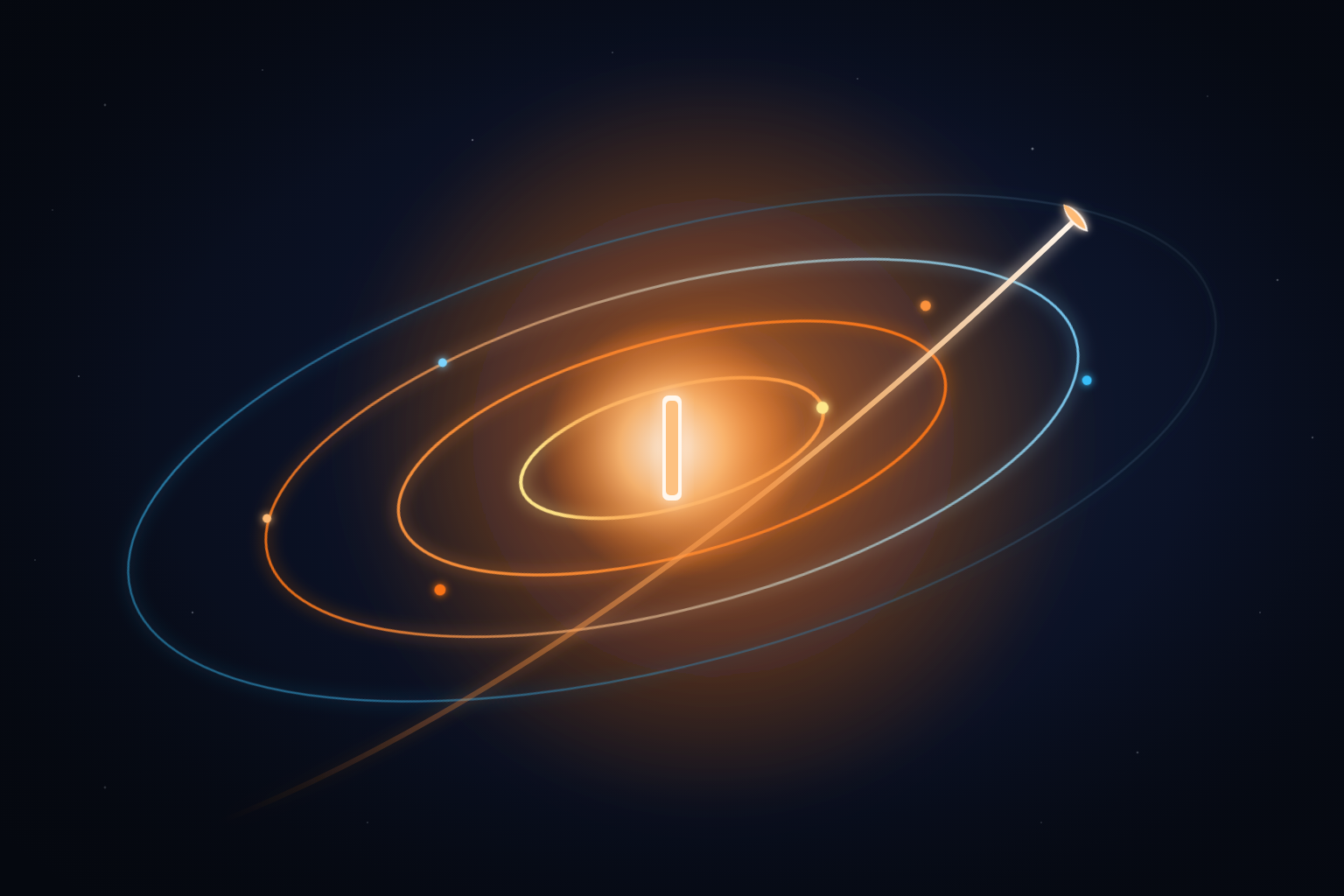
Let me say it plainly: this article is not a prosecution, and the point is not whether one likes the man. The object is more instructive. What Musk is assembling before our eyes is the best-funded attempt ever made to close a full production loop, from code all the way to energy. And one has to understand that there is not one loop but four, nested like Russian dolls. At every scale the same gesture repeats: internalize every link of a chain so that it ends up running on its own, the human reduced to an exception one agrees to call upon. My thesis, in one sentence: Musk is not buying a code editor, he is buying the link that lets the loop close on itself. Everything that follows has been verified, and the inflated figures of the popular account are corrected along the way.
Four loops, one gesture
Before the detail, the map. Musk's strategy is often mistaken for a collection of unrelated companies. It is the opposite: each company is a link in a single chain, and that chain closes at four distinct levels.
| Scale | The loop | What it closes |
|---|---|---|
| 1. Code | The software factory | write, review, merge and ship with no human in between |
| 2. Compute | The economics of inference | capital that funds its own fuel |
| 3. Industry | The physical machine | chips, energy, robots and data under one roof |
| 4. Intelligence | Self-improvement | progress that ends up not needing us |
The beauty, and the danger, of the design is that these loops feed one another. Code feeds the models, the models justify the compute, the compute produces the data, the data improves the code. Let us take them one at a time.
First loop: the software factory
This is the visible loop, the one announced at the conference. Cursor is no longer an editor, it is an assembly line. You write the code in the editor, a fork of VS Code that became one of the most used in the world, with more than a million daily users, installed at Nvidia, Stripe and Uber. You delegate execution to agents running in the background or in the cloud. You review with Graphite, the code-review tool acquired in late 2025. And, the new piece, you host and merge with Origin, the GitHub competitor unveiled in June 2026.
Origin is precisely the link that closes this first loop. As long as code had to go through GitHub, wait for a human review, a continuous-integration run, a manual conflict resolution, the human stayed in the circuit. Origin is a Git forge built not for people but for swarms of agents: it resolves conflicts on its own, fixes its own failures, handles merge requests and only calls a human as a last resort. The demo figures give the intended scale, on the order of twenty-two commits per second in a single repository. No developer works at that pace. GitHub was built for someone who pushes a few times a day; Cursor bets that assumption is dead.
But the most valuable purchase is invisible. By owning the most used editor, you own the most complete archive in the world of how real engineers work with AI: which suggestions they accept, which they reject, how they correct. To train the next model, that real behavior is worth more than all the public code on the planet. GitHub sees the result; Cursor sees the gesture. And the usage loop feeds the training loop: more agents produce more traces, which make a better model, which launches more agents. Owning the hosting is no vanity, it is the exact point where you capture the data competitors, who stop at the editor, will never have.
Second loop: compute
Here lies the real reason it is Musk, and no one else, who takes the prize. The bottleneck of AI today is neither the model nor the application: it is compute, the scarce and expensive resource everyone is fighting over. And when you own the scarce resource, you can buy everything that depends on it.
The timeline is clear. In February 2026, SpaceX absorbed xAI, the lab that makes Grok, in an all-stock merger valuing the whole at around 1,250 billion dollars. SpaceX thus inherited Colossus, the giant supercomputer in Memphis. In April, SpaceX and Cursor signed a ten-billion-dollar collaboration, with an option to buy at sixty billion. In June, the listing, then the acquisition, paid in shares. The meaning of the sequence is undeniable: SpaceX is not diversifying into code, it is buying a customer of its own compute. Cursor already trained its models on Colossus. The money no longer flows only from the application up to the model, it flows up to the compute.
Paying in shares is no accounting detail, it is the heart of the mechanism. A buyer who has the cash and still chooses to pay in paper is telling you something precise: he would rather spend a currency whose value he sets himself. SpaceX stock is worth whatever the narrative of its dominance is worth (Mars, Starlink, data centers in orbit), and every spectacular acquisition feeds that narrative. Mathematically the valuation is untenable: SpaceX is worth nearly 1,800 billion dollars, ahead of Meta or Amazon, while Amazon earns about seventy-eight billion in net profit a year and SpaceX is not even profitable. Without the force of the story, the price makes no sense. Musk therefore converts a belief into acquisition leverage.
And this loop concerns you directly, even if you never open Cursor. For a narrative worth hundreds of billions to hold, it needs real capital. The index provider MSCI brought SpaceX into its standard indexes on 29 June, seventeen days after the listing, by loosening its own rules. The mechanical consequence: passive funds, the ones that hold the retirement savings of millions of people through a simple world ETF, are forced to buy the stock, for four to seven billion dollars of automatic demand. Senator Elizabeth Warren wrote to the SEC and to index providers to denounce this rushed inclusion. The S&P 500, for its part, refused the fast track. But the principle is set: a merger in Silicon Valley now has a mechanical effect on your savings.
Then there is the trap Musk set for himself, and it is the subtlest angle of the whole affair. Musk lost the war for the best coding model, and admitted it publicly: Anthropic won it. Grok stalls around 7% enterprise adoption. Yet most Cursor users stay for Claude and for OpenAI's models, not for Grok. Cursor's business model rested on neutrality: routing each request to the best available brain. But those brains belong to its two rivals. The supreme irony: Anthropic rents part of Colossus from SpaceX, for about 1.25 billion dollars a month, on a contract cancellable at ninety days. SpaceX rented it out because it could not run Grok on it properly. Musk has thus just paid sixty billion for a user base loyal to his two main competitors, who are also the tenants of his compute farm. His bet: to raise his new model to the point where he can tighten the screw on Claude and GPT without triggering the exodus.
Third loop: the industrial machine
Cursor is only one link in a far larger loop, of which the TeraFab project is the most brutal revelation. Announced by Tesla, SpaceX and xAI, this semiconductor plant targets a production capacity equivalent to about one terawatt of compute a year, on the order of fifty times current world output. The cost, first put around twenty billion, has been revised toward one hundred and twenty billion in the latest regulatory filings.
The logic, once again, is to remove a dependency. Today Nvidia designs the chips, TSMC makes them in Taiwan, the giants use them. Demand for the finest chips already exceeds supply threefold. TeraFab wants to repatriate everything. But making the chips does not solve the thermal wall: cooling accounts for thirty to forty percent of a data center's consumption. Hence the dizzying shift: roughly 80% of the compute would go to space, 20% would stay on the ground. In orbit, the hotter a system runs, the more efficiently it radiates, where Earth imposes the reverse, and the sun never sets. Starship targets a cost to orbit below ten dollars a kilo, against several thousand for the competition. At that price, shipping data centers into the sky stops being science fiction.
And the loop closes at the level of the companies, by replaying exactly the move that made SpaceX: Starlink had ordered most of SpaceX's launches, guaranteeing the volume that makes reusable rockets pay. The same pattern returns. TeraFab produces the compute; xAI exploits it to train the models, it is the brain; Tesla embodies it in the real world, with its Optimus robots whose internal outlet, tens of millions of units targeted, guarantees the plant's order book; Tesla and the social network X send back the fresh data that retrains the models; Starlink distributes; SpaceX transports. Compute produced by TeraFab, exploited by xAI, embodied by Tesla, which returns the data: that is the full loop, at industrial scale. In this design, Grok is no longer a flagship product, it is an interchangeable component. The thesis is sharp: if the model becomes a commodity, and it does, the advantage is no longer in making it but in controlling the whole chain, from energy to data.
Fourth loop: the intelligence that does without us
The last loop is the one all the others prepare, and it is the one that makes you dizzy. Until now, the fundamental limit of any technology was the speed at which humans adopted it: progress was measured by the growth in the number of users. The S-curves of electricity, over fifty years, then of the smartphone, over a few years, grow steeper and steeper, but they stayed bounded by us.
The bet Musk and a few others make for the end of the decade is that AI becomes able to adopt itself. Growth then decouples from us. A general intelligence puts its own intelligence to work on its own development, and gives rise to a superior intelligence in a self-improvement loop whose end no one knows. That is precisely why Musk keeps saying that Starship is probably the last great entirely human invention.
And this is where the four loops turn out to be only one. The software factory that ejects the developer from execution is the same movement, in miniature, as the economy that decouples value creation from the saver, as the industry that replaces the worker with a robot, as the intelligence that advances without a human brain in the loop. At every scale, the human is removed from the circuit, and it closes. The end point of this logic Musk states himself. Asked about the meaning of existence in a world of total abundance, he answers that you cannot have both at once: limitless abundance and necessary work that gives meaning. In a world without scarcity, therefore without money to arbitrate it, every allocation decision is made one notch above you. You can be happy there like a well-treated dog with its owner, but not free, since to be free is to make choices in the face of uncertainty. The loop, perfectly closed, no longer needs us to turn.
True and false
A subject this spectacular attracts inflated figures, and the enthusiasm of commentators quickly distorts the facts. Let us sort them.
True and verified: the sixty-billion-dollar acquisition paid in shares; SpaceX's absorption of xAI in February, which puts Colossus under the same roof; the fact that Composer 2.5, Cursor's in-house model, ranks third on the reference coding-agent index of the firm Artificial Analysis, behind only the most expensive variants of Opus 4.7 and GPT-5.5, at a cost ten to sixty times lower per task; Anthropic's lease of Colossus; the forced entry into the MSCI index and Elizabeth Warren's letter.
False or distorted, and worth correcting. The newly announced model does not have one and a half billion parameters but one thousand five hundred billion, that is 1.5 trillion, in the class of the largest models from Anthropic and OpenAI; and it is this model, not Composer 2.5, that is trained from scratch, with no open base, on more than one hundred thousand graphics processors. Composer 2.5 is nothing like a model built from nothing: it is a mixture-of-experts of about one trillion parameters built on a Chinese open base, Moonshot's Kimi model. Anthropic does not pay twenty-five billion a year to rent Colossus, but closer to fifteen, about 1.25 billion a month. And the Cursor value often cited at eighty billion is a confusion: the acquisition price is sixty. Understanding the real mechanism makes the fantasy unnecessary.
The loop, in one sentence
In the end, the pattern is strikingly simple. Four loops, one and the same gesture repeated at every scale.
| Loop | The gesture | What is left of the human |
|---|---|---|
| Code | write, review, merge, ship as a chain | an exception, called when needed |
| Compute | capital funds its own fuel | a saver who pays without knowing |
| Industry | chip, energy and robot under one roof | an outlet, then nothing |
| Intelligence | progress that sustains itself | a benevolent owner, and us, the dog |
So the real question is not whether Musk got a good deal buying Cursor. It is what becomes of an economy, and soon a society, every link of which has been designed to do without the human who used to be there. Musk's bet could in fact fail on a detail: he paid sixty billion for an audience loyal to his rivals, and his whole strategy rests on the still-unproven promise that his next model will be good enough to keep it. But the direction is clear. We close the loop, and at the center, where someone used to be, a cursor keeps blinking.