
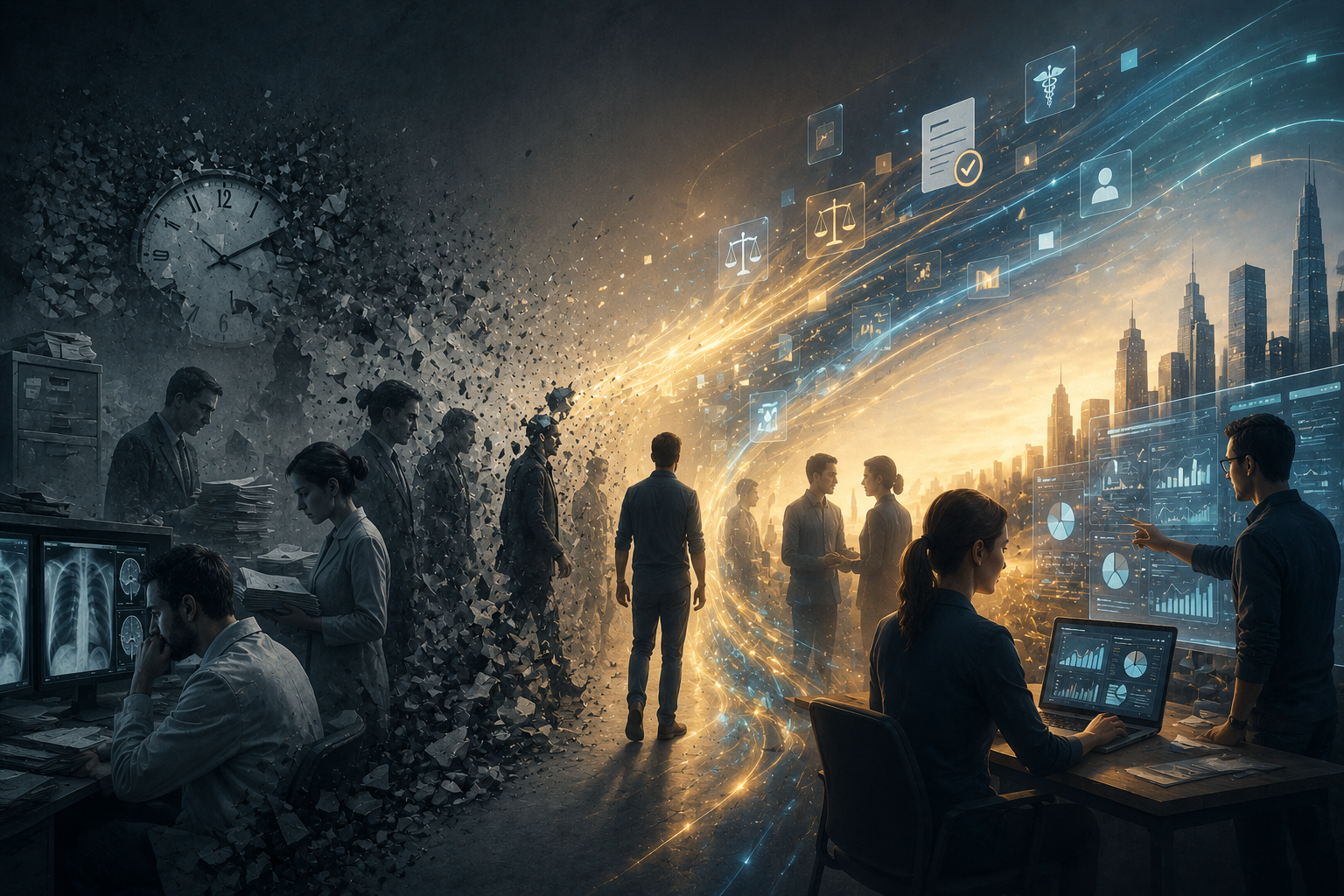
The Lesson of the Radiologists
In late 2016, before an audience of specialists, Geoffrey Hinton, the same researcher who, nearly ten years later, would share the Nobel Prize in physics for his foundational work on neural networks, made a prediction that is still discussed today. He put it roughly like this: if you are a radiologist, you are like the coyote that has already run past the edge of the cliff but who has not yet looked down. And he went on to say: we should stop training new radiologists right now, because it is completely obvious that, within five years, deep learning will do the job better than they will.
That prediction was, on technical grounds, largely justified. At the time, the first convolutional networks trained on banks of medical images were beginning to beat the best human radiologists on several precise tasks: detecting pneumonia on chest X-rays, spotting pulmonary nodules, segmenting tumors. The trend has only accelerated in the years since. Today, AI-assisted diagnostic tools are widely deployed in the major medical centers of developed countries, with some large hospital systems, such as Advocate Health in the United States, having evaluated 225 solutions to select roughly 40, even though their penetration remains uneven outside major institutions and in rural areas. On the precise technical act of looking at an image to detect an anomaly, AI is, in many cases, better than the human.
And yet, nine years later, in 2025, we are not training fewer radiologists than in 2016. We are training more. The headcount in the specialty has increased in nearly every developed country. The Mayo Clinic, one of the most prestigious medical centers in the United States, has seen its team of radiologists grow by fifty-five percent since Hinton's prediction, now reaching 400 practitioners. In the United States, the American College of Radiology projects, for the next thirty years, a headcount growth of roughly 26 percent. Hinton himself, when questioned about this divergence, candidly conceded that he had been wrong "on the timing".
To a distant observer, the conclusion seems simple: the prediction was false, the profession did not disappear, the fears were exaggerated. That is, in chorus, what the recent defenders of the thesis that AI will replace no one are saying. Jensen Huang, the head of Nvidia, has made the radiologists' anecdote his preferred argument: see, he says on stage, where everyone predicted the disappearance of a profession, the opposite is observed. AI makes radiologists more productive, the market demands more imaging, more radiologists are hired. Aaron Levie, the founder of Box, makes analogous use of the case: the value of a radiologist does not lie in the task performed, it lies in the purpose served, and AI can take over the former without touching the latter.
This reading is, in part, correct. It is correct enough that one cannot dismiss it with a wave of the hand. But it is also, as we shall see, a bit hasty. For Hinton's prediction was not only wrong on the timing: it rested on an implicit model, namely a profession equals a task, which is probably, in the long run, the wrong model for thinking about what is happening. The fact that radiologists have not disappeared in five years does not mean that Hinton's prediction can be wholly discarded. It means that the boundary between what AI replaces and what it does not replace runs somewhere other than where Hinton thought it did.
It is this boundary that must be named. And it is precisely from the lesson of the radiologists that one can begin to do so, not by taking it as a definitive refutation, but by asking what it teaches us, in what it confirmed and in what it disproved. The technical prediction was good. The sociological prediction was bad. The distinction between the two is precisely what should organize the entire reflection that follows.
Task vs Purpose
If Hinton's technical prediction was borne out and his sociological prediction was disproved, it is because a profession is not a task. It is, strictly speaking, a bundle of tasks, organized by a purpose, to use the Anglo-Saxon word, and that is precisely the word Jensen Huang uses when he comments on this story on stage.
His formulation is worth quoting precisely. The radiologist's purpose, Huang says, is not to look at images. The radiologist's purpose is to care for patients. Looking at images is one of the tasks performed in order to reach that purpose, but it is not the purpose itself. When an AI takes over that task, it does not take over the purpose: it frees the radiologist to spend more time on it. It is this distinction (the task one automates versus the purpose one serves) that explains why a profession can absorb the automation of one of its central tasks without disappearing. Better still: why it can, in the process, gain in value.
The argument is convincing for the radiologist. It is also convincing for the surgeon, the notary, the teacher, all professions whose visible task (operating, drafting a deed, giving a lecture) is being substantially assisted by tools, without the purpose served by these professions (caring, securing a transaction, transmitting knowledge) ceasing to require a human. Aaron Levie, the founder of Box, draws a reassuring moral: he says you need humans at the entry and exit of any important process, and AI efficiently handles the middle.
But this reasoning, which we have seen confidently defended by Huang, Levie, and their emulators, does not have the generality attributed to it. It works for professions where the central task can be distinguished from the purpose without difficulty, that is, professions where there exists, in addition to the task the AI can perform, an irreducible zone of action: relationship with the patient, ethical judgment, legal responsibility, physical presence. It works less well, and this is where Huang's reading becomes lazy, for professions where the task is the purpose.
Consider the case of the middle manager, the intermediate cadre who populates the org charts of large companies. The central task of a middle manager is, most often, the orchestration of information: she consolidates what the teams below her produce, she turns it into intelligible summaries for the teams above, she relays instructions in the other direction, she arbitrates between the contradictory demands that come up. What is her purpose? If we accept Huang's grammar, we should be able to formulate it independently of the task. But in a significant share of services organizations, doing this rigorously turns out to be difficult. One will object, rightly, that coordination, social arbitration, internal politics, and human responsibility also belong to the role, and that one cannot reduce it in one stroke to the orchestration of information. Still, to my mind, in these organizations, the effective value of the middle manager lies largely in that orchestration function: it is what occupies most of her time, it is what she is evaluated on, and it is precisely the part of the role that some AI agents are beginning to take over credibly when well integrated into work flows. The social and political dimensions of the role do not vanish for all that, but they prove insufficient, taken alone, to justify a middle layer as thick as the one that exists today.
Diana, a partner at Y Combinator, writes it plainly in a recent note on what she calls AI-native companies: in these organizations, there is no longer, or almost no longer, an intermediate layer of human management. The intelligence layer, as she puts it, plays that role. Agents read tickets, listen to recorded meetings, synthesize customer feedback, propose sprint plans, raise alerts on deviations. The humans who remain are, on one side, those who execute a specific piece of work (the individual contributors), on the other, those who own strategic decisions (the DRIs, directly responsible individuals). Between the two, no one. Or almost no one.
That is the nuance the too-quick reading by Huang obscures. Where the purpose is clearly distinct from the task, automation frees; where the purpose merges with the task, automation threatens. The radiologist survives because her purpose is not the reading of images. The middle manager may not survive, or will survive in a profoundly reshaped form, because her purpose is, precisely, the circulation of information. The same grid applied to other professions yields uncomfortable results. The press-review journalist, whose purpose is to filter the news, is exposed. The administrative assistant, whose purpose is to coordinate calendars, is exposed. The first-line sales representative, whose purpose is to qualify leads, is exposed. In all these cases, the task/purpose distinction saves nothing: it names exactly the zone where these professions will have to reconfigure, heavily, and probably fast.
Software Factories and the Engineers Who Remain
At the end of 2025, Andrej Karpathy posted on the social network X a message that circulated for weeks: "I've never felt this much behind as a programmer. The profession is being dramatically refactored, because the share of code written by the programmer is rarer and rarer and shorter and shorter." The post was viewed millions of times, retweeted by tens of thousands of developers who recognized, in this phrasing, their own vertigo.
The admission, coming from one of the most respected engineers of his generation, deserves attention. Karpathy is not a beginner discovering the tool. He has spent years training the very models he now says outpace him in his daily practice. If he feels behind, it is less because the tools have become hard to use than because they have become good enough to render obsolete the way he himself was thinking about the craft. The craft has not disappeared. It has reconfigured. And what it was yesterday (writing code line by line, organizing functions, debugging errors step by step) is no longer what is asked today of a senior engineer.
To grasp the scale of this reconfiguration, one must look at what some pioneer teams are doing in practice. The example that comes up most often in the technical conversations of 2025-2026 is that of StrongDM, an American cybersecurity company that published, in early 2026, a detailed description of what it calls its Software Factory. The internal rule is radical: no code is written by a human; no code is read by a human. The main repository of the team's new product contained, originally, three Markdown files. These three files described, in natural language but with demanding rigor, the specification of the software one wanted to bring into existence. From this specification, an AI agent, named Attractor, writes the code, writes the tests, runs the harnesses, iterates until the suite of scenarios defining success is satisfied. A second, more refined version comprises 16,000 lines of Rust, 9,500 lines of Go, and 6,700 lines of TypeScript, none of them written by hand.
The example is still extreme. It is not, for all that, anecdotal. Diana, a partner at Y Combinator, presents it in a recent note as the emerging paradigm of AI-native companies: software development no longer consists of writing code, it consists of writing specifications and letting agents produce the implementation. Human work moves upstream (design, constraints, scenarios) and downstream (supervision, validation of edge cases). The middle layer, the one that consisted of transcribing ideas into executable lines of code, is being absorbed by the machine.
At this point, one would expect the employment figures for developers to collapse. Yet the observation is the reverse, and it is this we must try to explain. Major American companies continued, in 2025, to hire software engineers in large numbers. Aaron Levie, the founder of Box, who is a structural vendor to the Fortune 500, makes the point: not a single one of the major companies he works with has, to his knowledge, reduced its engineering headcount in recent years. Most continue to hire. How do we reconcile this with the mass diffusion of software factories? A simple formulation organizes what seems paradoxical: the engineering function does not disappear, it shifts, from writing code to specification, verification and integration. Today's engineer is no longer paid to write functions. She is paid to formulate what must be done, to verify that the agent did it correctly, and to connect the result to existing systems. Fortune 500 firms hire at a sustained pace, but they hire profiles whose effective production, measured in human-written lines of code, is probably lower than five years ago, and whose effective production, measured in delivered software, is very probably higher.
That is, to my mind, the right model for understanding what is happening at scale. AI does not eliminate the engineering profession. It sharply augments its productivity, and it shifts its center of gravity. But this shift is, in some respects, harder to live through than a simple disappearance would be. It forces competent people to relearn, mid-career, what is expected of them. And it leaves, by the side of the road, those who will have neither the time nor the resources to do that relearning. These people do not disappear either. They slide into other roles, generally less well paid. The machine does not eliminate employment: it redistributes its value.
The Invisible Work AI Creates
The image that pessimists in the French debate hold of AI is that of a machine that swallows jobs and gives nothing back. The image that optimists oppose to it is that of a machine that frees up time and allows everyone to upskill. Neither of these images describes what is actually happening, in practice, in the companies that have begun to deploy agents seriously. What is happening is subtler, and more worrying for some, more reassuring for others: AI is creating a considerable mass of new work, scarcely visible, poorly remunerated for now, but without which the agents do not function.
Aaron Levie gives, in several recent interviews, a precise example that is worth citing because it rings true. The scenario is mundane. An agent is asked to cross-reference two sources of information about the customers of a small company: the Stripe application, which handles payments, and the Google account, which handles user accounts. Stripe identifies its customers by email address. Google identifies its users by email address as well. The agent, left to itself, does what one expects of good intelligence: it cross-references the two by email. Except that, in practice, the same customer may open her Google account with a personal address and pay with a professional one, or the reverse. The agent then cross-references falsely, attributes to customer A payments that belong to customer B, and produces false accounting. No classic validation system detects this kind of error, because everything is syntactically coherent. It takes a human to discover that the cross-referencing grid was bad, and another to decide on a stable internal identifier that makes the error impossible.
This kind of scenario occurs in thousands of places, across all organizations that deploy agents. Each of these places creates human work downstream of the agent's action, to verify, correct, recalibrate. This is not the romantic work of strategic expertise. It is not the simple passive supervision either. It is a specific kind of work, which is starting to be called human in the loop, and which consists of standing ready, downstream of each agentic chain, to arbitrate what the agent will not be able to settle.
This profession does not yet have a name. It has, for the most part, no dedicated training. It is scattered across existing functions (assistants, operators, quality, audit) which see a growing share of their time devoted to examining the outputs of agents to detect subtle errors in them. Developers themselves do part of it, as we saw in the previous section: the specification written before the agentic session, the review of edge cases, the debugging of drifts. But another part is done by people who are not, a priori, technicians. It is the lawyer who proofreads the conclusions produced by a legal assistant. It is the doctor who validates the diagnosis prepared by a decision-support tool. It is the accountant who spends half a day understanding why the automatic reconciliation has misallocated a series of transactions.
The legal case deserves attention, because it illustrates the very nature of this work. An AI assistant, asked to prepare a memorandum on a given question of case law, will produce a perfectly formed text. It will most often cite existing rulings, in a format that resembles that of the profession. It may also, on occasion, hallucinate a decision that was never handed down, or attribute to a real decision a reasoning that actually comes from another. For an uninformed reader, nothing distinguishes the two. For the jurist who proofreads, however, the detection requires specific work: verifying the existence of each reference, checking that the attribution is accurate, cross-referencing with the official database. This work does not coincide either with the classic drafting of the jurist (which the machine has already done in her place) or with the customary critical reading of case law (which assumes, by convention, that the references are accurate). It is a new kind of work: a forensic audit of agent outputs, required by their capacity to produce falsehood that resembles truth. The same kind of task is found, with some nuances, in press rooms that use assistants for documentary reviews, in compliance services that have regulatory summaries generated, in accounting firms that have forecast reports produced. The presence of a specialized human downstream of the agent is not a luxury. In all these professions, it is the condition for the output to be usable.
The model that is taking shape is not that of an economy without work. It is that of an economy where human labor concentrates, in layers, around the points where the machine can produce costly errors without noticing them. At Anthropic, the team that developed skills, structured folders that give an agent specific expertise in a narrow domain, describes exactly this dynamic. The human's role is no longer to execute the task. It is to design the frame within which the agent will execute it. Designing a skill means drafting rules, organizing reference files, writing tool scripts, anticipating the cases where the agent will deviate. The result, paradoxically, can be that a task once done in thirty minutes by a human becomes a task done in two minutes by an agent, but one that required, to exist, several hours of upstream design by a human expert.
This redistribution of work has an economic consequence that is not measured enough. Visible work decreases. Invisible work increases. Monetary value follows, for the moment, the visible (that is, the work of the agents), and the humans who attend to the invisible work are, in most cases, under-paid relative to their real contribution. This gap is, in the long run, untenable. Either it will be corrected by a revaluation of the human in the loop, which will become a recognized profession with its own training channels and salary scales, or it will be maintained, and added value will slide massively toward those who own the agents, at the expense of those who repair their errors.
What Resists
If some tasks resist automation, it is not by chance, and it is not because they are mysteriously "human" either. They resist because they share a precise property, a property that can be named, and whose cartography is beginning to take shape.
The first of these properties is accountability. Aaron Levie put it in a sentence sharper than most analyses we have read on the subject: "I can fire the human, I can't sue the weights". When a decision goes wrong (a surgery that goes badly, a financial placement that ruins a client, a verdict that turns out to be unjust) society needs someone to answer for it. Not for the satisfaction of punishing, but for what in law is called the function of responsibility: to make a stopping point exist in the chain of causes, a place where the decision was made and where it can be reviewed. AI agents, by construction, do not have this property. They possess nothing that can be seized. They sign no minutes. They do not appear in court. However competent an agent may be, there will always be, downstream of its intervention, an identifiable human whom society will require to be held responsible. This requirement is not a legal whim. It is the very condition of the institution.
The second property is more technical. Andrej Karpathy speaks of it in his Y Combinator interview from the autumn of 2025 under another form: he describes precisely the domains where agents, including the best ones, struggle to establish themselves, and observes that these are the domains where the cost of an error is asymmetrically higher than the benefit of a success. An agent that succeeds in coding a function in one second and fails one time in a thousand is a good deal. An agent that succeeds in driving a million kilometers and causes a fatal accident one time in a thousand is a catastrophe, not only moral, but legal, media-related, economic. The boundary that separates the automatable from the non-automatable is not that of technical difficulty. It is that of the marginal cost of error. Where this cost is low, agents take over quickly. Where it is high, they take over slowly, and always under supervision.
The third property is less often discussed, and is perhaps the deepest. Geoffrey Hinton, in the lecture mentioned in the second essay of this series, draws attention to an asymmetry that tends to be underestimated: large language models, because they can be duplicated identically, can also share among themselves what they learn at speeds inaccessible to humans. When two identical models run in parallel in two data centers and their weights are synchronized, they can exchange billions of bits of information per second. When two identically trained humans want to share what they have learned from an experience, they are limited by the slow and lossy throughput of conversation. This asymmetry does not appear in the term-by-term comparison between a human and an agent. It appears in the comparison between hundreds of humans and hundreds of copies of the same agent. At that scale, the agent ends up knowing things that no human would ever know, for lack of being able to share fast enough. This property does not describe a specific profession that would resist. It describes what, in the very long run, tips the balance one way or another. The domains where accumulated experience is crucial (rare medical diagnosis, high-reliability engineering, information security) are those where this asymmetry plays most powerfully, and most unfavorably to the human.
To these three properties is added, finally, what could be called sensible presence. There exists a category of human relationships (nursing care, social accompaniment, conflict mediation, educational presence) whose value lies precisely in not being mediated by a machine. This category is not immune to competition from agents. The mass adoption of chatbots for psychological support is now documented: according to a Psychology Today survey published in 2025, 48.7 percent of the American adults surveyed say they have turned to an AI chatbot for support of this kind, and Replika alone claims more than 10 million users. The motive invoked is almost always the same: the possibility of speaking to an available interlocutor, perceived as non-judgmental, in moments of stress or anxiety. This preference is not trivial. A study published in January 2026 in JAMA Network Open, covering nearly 21,000 American adults surveyed in the spring of 2025, observes, among daily users of these tools, an association with a higher probability of depressive symptoms, on the order of 30 percent compared with non-users. This association, as is always the case in this kind of survey, does not by itself allow a simple causal inference, but its authors cautiously advance the hypothesis that the gradual replacement of human interaction by algorithmic interaction could, over time, degrade the very springs of social support. Whatever share of causality subsequent work confirms, the observation is that there is very broad social demand for non-human interlocutors, and that this demand coexists with long-term effects we are only beginning to measure. The social value of sensible-presence relationships, their function in the human fabric, remains, to this day, irreducible to what a machine can produce. But it is precisely this irreducibility that is being tested, at scale and without a frame. In the landscape of automation, it is a zone of stability that is too little attended to, because it does not make the headlines.
Four properties, then, and four zones of relative stability. None is definitive. All call for being watched, because the boundary between what resists and what allows itself to be replaced is in constant motion. But having a cartography of it, even an imperfect one, is more useful than abstractly opposing "the professions that will remain" and "the professions that will leave". What will remain is not professions as blocks. It is precise fragments of each profession, those rooted in one of these four properties. The rest, in the long run, is in play.
Schumpeter Put to the Test
At each wave of automation over the past two centuries, Schumpeter has been summoned. Creative destruction, he said, destroys old jobs and creates new ones. The latter are generally more productive and better paid than the former. The balance of the operation, in the medium term, is positive for society. This grammar has been summoned for mechanical weaving, for the railroad, for electrification, for computing, for the internet. It is summoned today for artificial intelligence, with the same confidence and the same rhetoric. You will upskill, we tell the service-sector employees whose central task is being automated. New jobs will appear, more interesting, more creative, better paid.
Is this grammar correct today? I am not certain. And the uncertainty bears less on the net creation of jobs, which could indeed be positive at the aggregate level, than on the distribution of the value they produce. Schumpeter, in his classical model, implicitly assumed that productivity gains were captured by a large number of actors: entrepreneurs who innovate, employees who upskill, consumers who benefit from lower prices. The current wave, as it can be observed unfolding, does not validate this assumption.
Consider the full chain. The AI models that create the value are produced by a handful of companies, five, perhaps ten in the world, that capture the bulk of the margin. The infrastructure on which they run is dominated by two or three hyperscalers. The chips on which they train are designed by a single actor or nearly so. At each level of the chain, concentration is stronger than in previous industries, and the rents captured by the leaders more considerable. When a radiologist or a developer "upskills" to use these tools, she generates, certainly, more value than before. But a growing share of that value flows back, in the form of subscriptions, to the publisher who owns the tool. Productivity rises. Wages do not follow in the same proportions.
At the scale of society, this gives an odd Schumpeter: the creation of jobs is probably positive or neutral, but the concentration of value captured by the new jobs reaches an exceptional level, higher than what previous waves of computerization had let one see at the same scale. The OpenAI or Nvidia employee sees her salary and her equity valuation track productivity. The downstream employee, at the client that uses these tools, sees it much less. This diagnosis matches, at a broader level, what the OECD has been documenting in its Compendium of Productivity Indicators for several years under the name superstar firms: a small number of very large companies, whose productivity per hour is on the order of double that of firms with 10 to 20 employees, capture a disproportionate share of the gains of the decade, invest massively in information technology and in digitalization, and concentrate the bulk of innovation. Where artificial intelligence changes the picture is not in inventing the phenomenon, it is in amplifying it: it shifts the frontier of accessible productivity precisely toward the firms that have the means to absorb it, in infrastructure, in skills, and in capital. The promise of upward mobility that creative destruction carried is becoming a hollow slogan for the majority, and a magnificent reality for a minority.
What would be needed, to respond to this drift, is something other than the usual slogan of "upskilling". What would be needed, and this, to my mind, is the debate that should occupy us rather than the sterile question of whether the machine will replace the human, is to redefine what deserves, in society, to be remunerated. Not only the immediately measurable productivity. Not only the creation of software. The invisible work we have discussed, the sensible-presence work we have discussed, the audit and supervision work we have discussed, will not spontaneously enter the salary grids of tomorrow. They will enter if, and only if, we decide collectively that they must.
This decision is not technical. It is political, in the strongest sense of the word. And it is not, contrary to what one sometimes hears, already taken. It lies ahead of us, still intact. The real question of the coming years is not "which professions will disappear". It is "which work will we decide to remunerate". History will not say that AI replaced humans. It will say that we did, or did not, redraw the contours of what we considered work worthy of being paid. What we replace lies ahead of us. What resists lies within us.